
 English
  Spanish
  French
  German
  Italian
  Portuguese
 Best Robot Lawn Mower Battery Guide for Smarter Buying
Table of Contents
- Best Robot Lawn Mower Battery Guide for Smarter Buying
- What Makes the best robot lawn mower battery fit your yard
- Which best robot lawn mower battery chemistry works better
- When Should You Replace the best robot lawn mower battery
- Runtime and charge time benchmarks for robot battery performance
- Choosing an automatic lawn mower robot with better battery support
- Learn More About Battery
The best robot lawn mower battery is the one that matches your yard’s real workload, charging pattern, and long-term support, not simply the biggest pack on the spec sheet. This guide focuses on the battery decisions that matter most when comparing a best robot lawn mower, including chemistry, runtime, charge time, replacement timing, and service support. It also shows how each robot battery affects real mowing performance, so buyers can choose an automatic lawn mower robot with fewer ownership risks.
What Makes the best robot lawn mower battery fit your yard
The best robot lawn mower battery fits the yard’s actual workload, not just the mower’s marketing tier. Yard size, grass density, route complexity, slope, and recharge speed all shape how much usable work the mower can complete before it must dock again, which is why a larger pack does not automatically deliver a better ownership experience.
Start with the mowing pattern. A compact, flat lawn can work well with a smaller lithium-ion pack if the mower recharges quickly and resumes work efficiently. A more complex yard with narrow passages, denser grass, repeated turns, or longer climbing sections places a heavier load on the pack and increases the value of longer single-charge runtime. Husqvarna’s published specifications show how much that can vary even within one brand, from 50 minutes of typical mowing time on one charge for the 405X to 100 minutes for the 405XE NERA and 138 minutes for the 440 iQ.
Recharge behavior matters just as much as runtime. STIHL states that every iMOW uses a lithium-ion battery with smart charge management, allowing the unit to charge quickly when it needs to return to mowing and to charge more gently outside active mowing periods. That operating logic matters because a mower that docks, recharges, and resumes efficiently can outperform a higher-capacity machine that spends too much of the day stationary.
What homeowners should check first
- Look at typical mow time on one charge and typical charging time together, not as separate specs.
- Match the pack to real terrain load, especially slopes, thick grass, and multi-zone routing, because those conditions increase energy demand.
- Prefer platforms that publish battery chemistry, pack size, and charge data clearly, because transparent specs usually make long-term ownership easier to evaluate.
What dealers and installers should verify
For distributors, installers, and service teams, the right fit starts with zone count, slope profile, expected mowing frequency, and local supportability. A machine can look strong on paper and still become a poor recommendation if runtime drops sharply on steep lawns, if the charging dock needs frequent intervention, or if the battery path is unclear after year two or three.
Which best robot lawn mower battery chemistry works better
For most buyers, the practical answer is simple: standard lithium-ion remains the mainstream choice, while lithium iron phosphate becomes attractive only when a mower is designed around that chemistry and the buyer values longer cycle life and thermal stability over energy density. That is the safest way to compare battery types without overstating the case for either one.
Most current residential robotic mowers still use lithium-ion. Husqvarna lists Li-Ion on current Automower models, STIHL states that every iMOW uses lithium-ion, and eufy publishes a lithium-based pack with a stated watt-hour capacity and charge window for the E18. This makes lithium-ion the default chemistry most homeowners will encounter when comparing a best robot lawn mower shortlist.
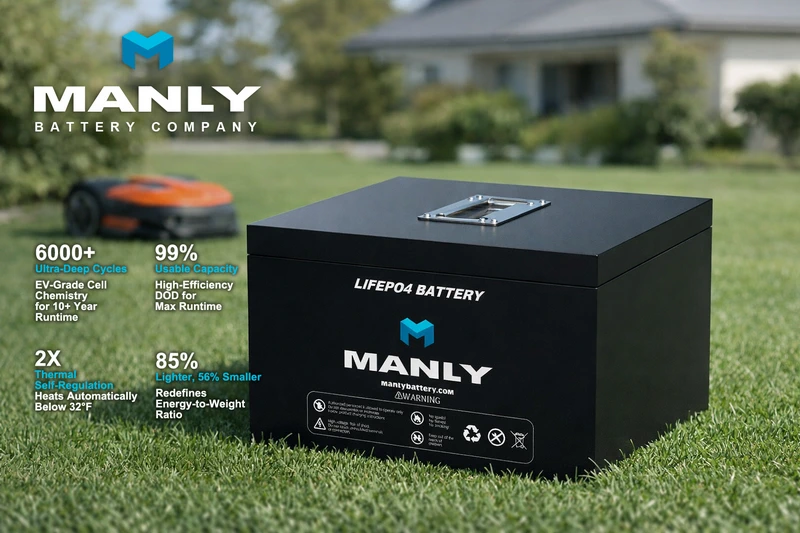
Lithium iron phosphate, often written as LFP or LiFePO4, has a different value proposition. The U.S. Department of Energy notes better cycle life and increased thermal stability for LFP in recent energy storage applications, and the IEA describes LFP as a lower-cost, less-dense lithium-ion chemistry with lower flammability and longer lifetime. In practical terms, that means an LFP pack can make sense when a manufacturer is prioritizing durability and long-term cycling rather than maximum energy in the smallest package.
That trade-off matters in mower design. Lower energy density usually means the platform needs more mass or space for the same stored energy, so buyers should not assume that “longer life” automatically means “better mower” in every yard. A compact residential unit that needs modest runtime and fast automatic recovery may still be better served by a conventional lithium-ion design, while a heavier-duty platform can justify LiFePO4 if the full system is built around it.
A clear chemistry rule for buyers
Choose standard lithium-ion when you want a proven mainstream platform with broad model availability and well-documented runtime behavior. Consider LiFePO4 only when the mower explicitly uses it and the platform’s value depends on high cycle durability, higher thermal tolerance, or a tougher all-terrain design.
What enterprise buyers should review
Commercial buyers should ask for three battery facts before approving any robot battery platform: the exact chemistry, the published cycle or retention claim for that exact pack, and the replacement path for that exact model. Chemistry alone is not enough, because pack design, charging logic, and field workload all affect service life.
When Should You Replace the best robot lawn mower battery
Replace the best robot lawn mower battery when the mower no longer maintains a reliable mowing schedule, not when the pack has failed completely. In real use, battery life changes with temperature, charging conditions, and duty cycle, so runtime loss, frequent docking, and incomplete zone coverage are more useful replacement signals than a generic calendar date.
NREL notes that lithium-ion battery lifetime varies with thermal environment and how the pack is charged and discharged. That is why two similar mowers can age differently in the field. A machine cutting a mild lawn on a stable schedule may keep usable performance much longer than one operating in hotter conditions, on a steeper site, or with repeated heavy-load cycles.
Model-specific battery claims also vary, so buyers should not force one universal replacement interval across every mower. ECOVACS states that the GOAT uses a lithium battery rated for more than 1,000 full charge cycles while retaining more than 70% of original capacity under those cycles. Lymow states that its LiFePO4 pack is rated for 2,000 or more charge cycles. Those figures point in the same direction: replacement timing depends heavily on chemistry and platform design.
Signs the battery is ready for replacement
- The mower returns to the dock much more often than it did under the same schedule.
- The unit stops completing zones or leaves unfinished sections that it previously handled in one cycle.
- Charge time stays normal, but mowing time falls enough to disrupt the weekly plan.
- Charging becomes inconsistent because contacts, ports, or the dock interface no longer maintain a clean, stable connection.
What service teams should do before replacing a pack
A battery swap should follow basic diagnostics, not guesswork. Check contact cleanliness, dock condition, software status, storage history, and recent mowing load before calling the pack defective. eufy and Mammotion both highlight charging-contact cleanliness as a maintenance issue, and STIHL recommends proper storage conditions and partial charge for longer battery service life.
Runtime and charge time benchmarks for robot battery performance
The most useful benchmark for robot battery performance is the balance between mowing time and charging time. Buyers often focus on amp-hours or watt-hours first, but real field productivity depends on how much cutting the mower completes per cycle and how quickly it can return to work.
A few published examples show why this balance matters:
- Husqvarna Automower 405XE NERA: Li-Ion, 5 Ah, typical mow time of 100 minutes, typical charging time of 90 minutes.
- Husqvarna Automower 440 iQ: Li-Ion, 7.5 Ah, typical mow time of 138 minutes, typical charging time of 54 minutes.
- eufy E18: 93.24 Wh battery capacity, 90 to 110 minutes of mowing time on one full charge, and 90 to 110 minutes of charging time.
- ECOVACS GOAT A3000 LiDAR: 5 Ah battery and a stated 45-minute charge time, with mowing productivity measured as 5,382 square feet in two hours including recharge time.
These figures show why one simple rule works better than raw capacity chasing: compare the full work loop. A mower with moderate runtime but quick recovery can perform better on a typical residential schedule than a model with a larger pack but slower turnaround. For bigger or more demanding sites, though, added battery reserve can still matter because it reduces dock visits and protects zone completion.
How to read the benchmarks correctly
Read runtime and charge data alongside coverage claims, terrain limits, and cutting width. A machine that covers more lawn per hour may deliver stronger real productivity even if its single-charge runtime looks similar on paper, because drive efficiency, blade width, and route planning also affect output.
What procurement teams should compare
For fleet, dealer, or project purchasing, compare four numbers on the same sheet: battery chemistry, pack size, typical mowing time, and typical charging time. Without all four, it is hard to judge whether a model’s battery advantage is real or just a spec-sheet impression.
Choosing an automatic lawn mower robot with better battery support
The right automatic lawn mower robot does not just have a strong battery on day one. It also gives the owner a workable battery path after purchase through published specs, sensible charging behavior, maintenance guidance, and a clear route to replacement or service.
Start with transparency. Stronger platforms publish battery chemistry, mowing time, charging time, and charge-management behavior clearly. Husqvarna, STIHL, and eufy all publish those details on official product or support pages, which makes it easier to compare models without guessing.
Then check supportability. Mammotion promotes detachable or replaceable battery designs on some models, and Lymow publishes a replacement battery product path for its mower line. That matters because battery support is not only about chemistry; it is also about whether the platform lets you keep the mower productive after the original pack starts to fade.
Finally, treat charging care as part of battery support. eufy provides direct troubleshooting guidance for poor charging caused by dirty contacts, Mammotion recommends regular cleaning of mower and dock contacts, and STIHL provides storage guidance for lithium-ion batteries. Brands that publish these basics usually create fewer ownership surprises than brands that leave battery care vague.
A short buying checklist
- Prefer an automatic lawn mower robot with published runtime and charge data.
- Check whether the battery is detachable, serviceable, or sold as a replacement part.
- Review the manufacturer’s charging, cleaning, and storage guidance before purchase, not after problems begin.
- Give more weight to battery support if the mower will run frequently, serve multiple zones, or operate on demanding lawns.
What channel partners should prioritize
If you are buying for resale, installation, or managed service, battery support should sit near the top of the approval checklist. Clear documentation, stable charging behavior, available replacement parts, and realistic runtime disclosures reduce service friction and protect margin better than headline battery claims alone.


