
 English
  Spanish
  French
  German
  Italian
  Portuguese
 Top Battery Solutions Companies Serving the U.S. Market in 2026
Table of Contents
The leading battery solutions companies serving U.S.m Energy, Eos Energy, and Stryten Energy. Their strengths cover custom LiFePO4 packs, telecom backup, industrial power, integrated grid storage, and long-duration energy storage. The right choice depends on application, voltage, storage duration, and integration scope.
A company that builds a 48V telecom battery solves a different engineering problem from a supplier delivering a multi-megawatt grid installation. For buyers comparing battery solutions, the useful question is not which brand is universally best. It is which battery company has the right technology and system capability for the project.
What Defines the Best Battery Solutions Companies?
The best battery solutions companies combine application-specific engineering, battery management, documented testing, and production capability. Buyers should compare voltage and capacity requirements, communication protocols, system integration, safety documentation, and delivery scale. These factors show whether a battery manufacturer can support a real operating environment rather than simply supply a battery with the correct nominal voltage.
Application-Specific Battery Engineering
Strong battery engineering starts with the load and operating environment. Designers need to match nominal voltage, Ah capacity, kWh, continuous current, peak current, temperature range, enclosure, and available installation space.
A telecom backup system, industrial vehicle, solar storage system, and utility BESS do not use identical design criteria. The battery must fit the equipment and duty cycle.
Battery Management Systems and Communication Protocols for Integration
A battery management system monitors and controls critical pack conditions. Its functions may include cell voltage monitoring, current and temperature protection, balancing, and charge or discharge control.
CAN and RS485 communication can also support data exchange with compatible chargers, inverters, controllers, or monitoring equipment. The required communication architecture depends on the complete system rather than the battery alone.
Compliance, Testing, and Supply Capacity for Commercial Projects
Commercial buyers should review test documentation, certifications required for the intended installation, production capacity, and quality control before approving a supplier.
For stationary energy storage, UL 9540 evaluates energy storage systems and equipment across areas including charging, discharging, protection, controls, and device communication. UL 9540A addresses thermal runaway fire propagation testing for BESS. The applicable requirements still depend on system type and installation. ons Companies Stand Out in 2026?
Several battery solutions companies stand out because they address clearly defined parts of the battery market. MANLY Battery focuses on customized LiFePO4 packs and application-specific systems, while Tesla, Fluence, and LG Energy Solution Vertech serve large energy storage projects. EnerSys addresses critical industrial power, and Form Energy, Eos, and Stryten provide distinct approaches to longer-duration storage.
MANLY Battery: Custom LiFePO4 Solutions
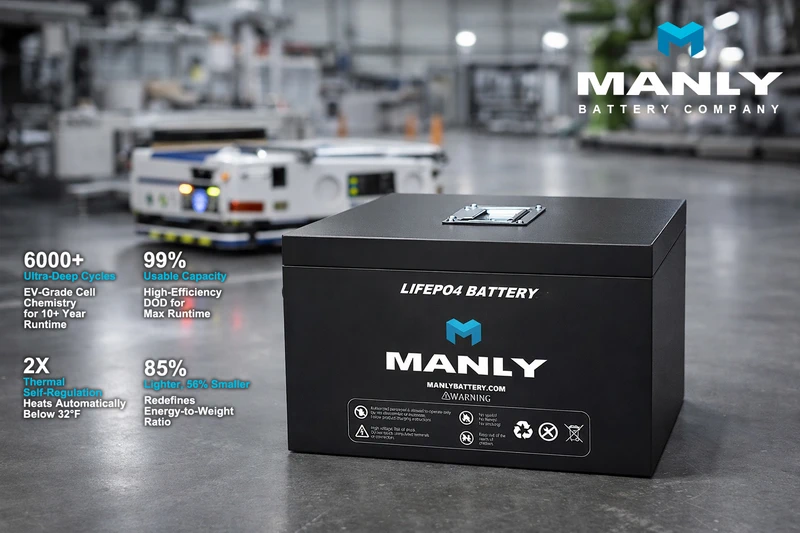
MANLY Battery is a China-based battery manufacturer serving international buyers that need customized LiFePO4 battery solutions. Its product range covers 12V to 72V configurations, while its official product catalog highlights custom voltage, capacity, current, dimensions, and communication options for OEM and project requirements.
duction of more than 3,000 batteries per day and approximately 6 MWh of daily output. This combination of customization and production scale makes MANLY particularly relevant to telecom, energy storage, UPS, and industrial battery procurement.
Battery for Telecom and ESS
MANLY offers a 48V-class 100Ah LiFePO4 platform for applications including telecom and energy storage. The MLP48100A product family lists 100Ah nominal capacity and an integrated BMS, with dimensional and electrical customization available for project requirements. inal battery energy, a 48V/51.2V 100Ah configuration can support rack-based backup or modular storage designs when its current ratings, charging equipment, and runtime calculation match the load.
20kWh All-in-One Energy Storage System
MANLY’s 20kWh all-in-one energy storage system moves from an individual battery pack toward integrated storage. Its published specifications list CAN and RS485 communication support, allowing compatible system components to exchange operating data.
tinction is integration scope. A packaged storage system may reduce the engineering work required to combine separate battery modules and control interfaces.
Utility-Scale Lithium Storage Platforms
Utility-scale battery solutions require more than battery cells. Large projects combine battery modules, thermal systems, power conversion, controls, software, monitoring, and long-term operational support.
Tesla Megapack for Utility-Scale Storage
Tesla positions Megapack for commercial and utility-scale energy storage. The system ships with integrated battery modules, bidirectional inverters, and thermal systems, while Tesla also provides monitoring through its energy infrastructure. cture suits projects that need a standardized grid-scale storage platform rather than a custom low-voltage battery pack.
Fluence Gridstack Pro for Grid-Scale Projects
Fluence developed Gridstack Pro for grid-scale storage used by utilities, power generators, and energy suppliers. The platform combines battery modules, battery management, monitoring equipment, and Fluence software within a unified architecture.
nkey configurations and remote monitoring services, making system-level integration a central part of its offering. Vertech for Integrated BESS
LG Energy Solution Vertech operates as an energy storage system integrator. Its services cover full system integration, forecasting tools, on-site maintenance, and long-term support through the operating life of a storage project. its buyers seeking integrated BESS delivery and lifecycle services rather than an individual battery module.
Long-Duration and Industrial Power
Long-duration and critical-power projects create different requirements for battery solutions companies. Storage duration, response requirements, site footprint, chemistry, and operating duty can shift the selection toward industrial reserve batteries, iron-air systems, zinc batteries, or flow battery technologies.
EnerSys for Industrial and Reserve Power
EnerSys supplies batteries, chargers, and power equipment for industrial, infrastructure, and critical-power applications. Its markets include communications networks, data centers, industrial power, utilities, and material handling. akes EnerSys particularly relevant where reserve power or industrial operations define the battery requirement.
Form Energy for 100-Hour Iron-Air Storage
Form Energy is developing grid-scale iron-air storage for multi-day applications. Its first commercial product is designed to store and discharge energy for up to 100 hours. places the technology in a different category from conventional short-duration grid battery projects.
Eos Energy for Zinc-Based Long-Duration Storage
Eos uses zinc-based chemistry in its Z3 battery platform. A Z3 module supports storage durations from 4 to more than 16 hours, and Z3 strings form the company’s Eos Cube and Eos Indensity systems.
ng-duration energy storage where project requirements extend beyond a short discharge window.
Stryten Energy for Multi-Chemistry Storage Systems
Stryten Energy works with advanced lead, lithium, and vanadium redox flow battery technologies. Its applications range from telecom and UPS to microgrids, utilities, warehouses, and distribution centers. proach allows project requirements to guide battery technology selection rather than forcing every application onto one chemistry.
How Do Battery Technologies Match Different Applications?
Battery chemistry should match the required power, energy, duration, installation, and operating profile. DOE assessments examine lithium-ion, lead-acid, flow, zinc, and other storage technologies as separate technical pathways. This is why experienced battery solutions companies select chemistry around the application instead of treating every energy storage project as the same battery problem.
and Industrial Systems
LiFePO4 is widely used in custom battery packs and stationary applications where designers value cycle performance, integrated BMS control, and modular voltage or capacity configurations.
For telecom backup, UPS, solar storage, and industrial equipment, buyers should still calculate current, runtime, charging voltage, and thermal conditions. MANLY’s customized 12V–72V range is an example of this application-led approach.
h-Energy Applications
Lithium-ion covers multiple chemistries and system designs, so buyers should not evaluate it as one uniform battery type. Cell selection, pack architecture, cooling, controls, and discharge profile all affect system design.
DOE identifies lithium-ion alongside other next-generation and stationary storage pathways, reinforcing the need to match technology to application requirements. Flow Batteries for Long-Duration Storage
Storage projects requiring many hours or multiple days of discharge may evaluate technologies beyond conventional lithium battery systems. ARPA-E describes long-duration storage as systems capable of discharging for 10 hours or more at rated power.
-hour iron-air storage, Eos offers zinc-based systems with 4 to 16+ hour durations, and flow batteries separate energy storage media from electrochemical stacks. DOE identifies scalability and decoupled energy and power as notable flow battery characteristics. mpanies by Application and System Scope
The leading battery solutions companies do not compete in every application on equal terms. A custom LiFePO4 supplier, an industrial reserve-power manufacturer, and a utility-scale system integrator deliver different products and engineering scopes. Buyers can make a more useful comparison by matching the supplier’s primary technology and integration model to the actual project.
| Company | Primary Battery Focus | Typical Applications | Main System Scope |
|---|---|---|---|
| MANLY Battery | Custom LiFePO4 | Telecom, ESS, UPS, industrial | Custom packs and battery systems |
| Tesla | Integrated lithium storage | Commercial and utility storage | Megapack platform |
| Fluence | Grid-scale BESS | Utilities and power projects | Storage integration and software |
| LG Energy Solution Vertech | Integrated BESS | Large storage projects | System and lifecycle services |
| EnerSys | Industrial stored power | Telecom, data centers, utilities | Reserve and motive power |
| Form Energy | Iron-air | Multi-day grid storage | 100-hour storage |
| Eos Energy | Zinc-based storage | Long-duration projects | Modular storage systems |
| Stryten Energy | Lead, lithium, vanadium | Telecom, UPS, microgrids | Multi-chemistry solutions |
These company scopes reflect their official product and solution portfolios. attery Partner for U.S. Projects
The right battery company should match the project’s electrical requirements, operating environment, safety and compliance needs, integration scope, and expected procurement volume. Buyers comparing battery solutions companies should define these requirements before requesting quotations. A clear technical specification produces a more meaningful supplier comparison and reduces the risk of choosing a battery based only on chemistry, brand, or nominal capacity.
Match Voltage, Capacity, and Runtime
Start with nominal voltage, Ah, kWh, continuous current, peak current, and required runtime. A battery with adequate energy capacity can still be unsuitable if its current capability or system voltage does not match the load.
Custom projects should also define dimensions, enclosure requirements, charging conditions, and communication interfaces before the battery manufacturer begins pack design.
Review Certifications, Warranty, and Support
Review the certifications and test documents relevant to the specific product and installation. For an energy storage system, system-level safety requirements differ from those for a standalone battery pack.
Buyers should also verify warranty terms, BMS documentation, communication protocols, and technical support. UL’s ESS guidance specifically treats protection, controls, charging, discharging, and device communication as system-level considerations.
on, Lead Times, and Scalability
Custom OEM buyers should compare electrical customization, BMS integration, engineering support, production planning, and expected lead times. Large BESS projects should place more weight on system integration, monitoring, deployment scope, and lifecycle services.
For a custom LiFePO4 project, prepare the voltage, required Ah or kWh, continuous and peak load, application, installation environment, communication requirements, and annual quantity. These specifications give battery solutions companies the information needed to propose a technically relevant system rather than a generic battery.


