
 English
 Spanish
 French
 German
 Italian
 Portuguese
Are LiFePO4 Batteries Better Than Lead-Acid for Data Center UPS Systems?
Table of Contents
- Are LiFePO4 Batteries Better Than Lead-Acid for Data Center UPS Systems?
- LiFePO4 vs. Lead-Acid Data Center UPS Batteries: Key Differences
- What Is the 10-Year Cost of a Data Center UPS Battery?
- MANLY Battery Backup Systems for Data Center UPS Projects
- Can You Replace Lead-Acid UPS Batteries With a LiFePO4 Battery?
- How Do You Size a LiFePO4 Battery for Data Center UPS Backup?
- Are LiFePO4 Batteries Safe in Data Center UPS Rooms?
- When Is a LiFePO4 Battery the Better Choice for a Data Center?
- FAQ
- Do data center UPS batteries need to provide hours of backup power?
- Can a 48V LiFePO4 battery support a data center UPS?
- Does a LiFePO4 battery last longer if the UPS rarely experiences outages?
- How often should a lithium data center UPS battery be inspected or tested?
- What battery information should a data center request from its supplier?
- Conclusion
Yes, a LiFePO4 battery is generally a better long-term investment than a lead-acid battery for a data center UPS system when service life, maintenance, space efficiency, and total ownership cost are priorities. Lithium iron phosphate technology can reduce battery replacement frequency while delivering dependable backup power in properly designed UPS installations.
However, choosing the right data center UPS battery involves more than comparing battery chemistry. A battery must deliver sufficient power during an outage, communicate correctly with the UPS, and support the required runtime until generators or alternative power sources take over.
This guide examines the performance and financial differences between LiFePO4 and lead-acid UPS batteries, explains the technical requirements behind reliable backup power, and explores MANLY Battery products for data centers and network infrastructure.
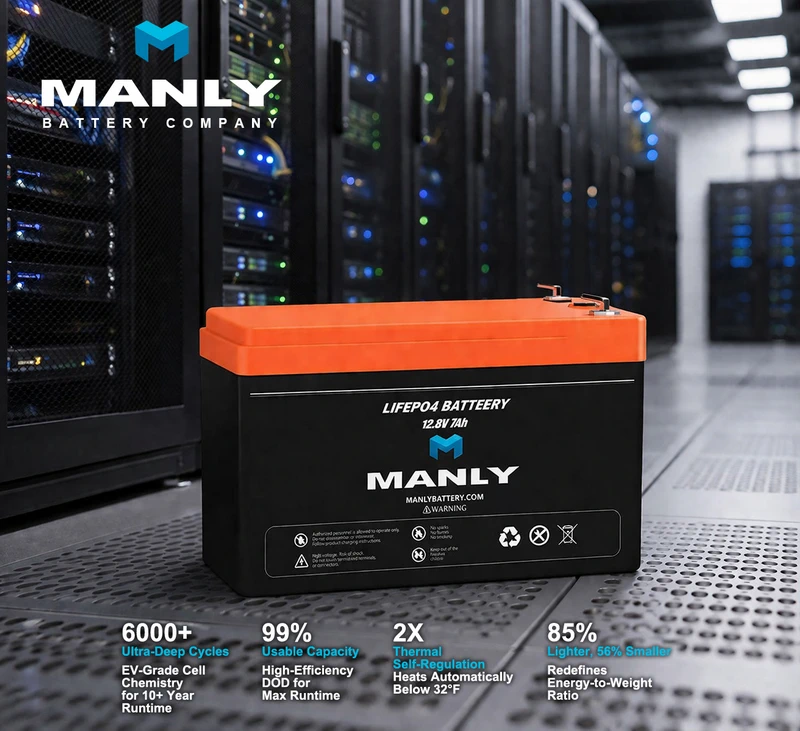
LiFePO4 vs. Lead-Acid Data Center UPS Batteries: Key Differences
LiFePO4 batteries offer important advantages in longevity, energy density, and maintenance requirements compared with conventional lead-acid batteries. For data centers operating around the clock, these characteristics can simplify long-term power infrastructure management.
Most conventional data center lead-acid UPS systems use valve-regulated lead-acid (VRLA) batteries, including absorbent glass mat (AGM) designs. LiFePO4, also called lithium iron phosphate or LFP, is a lithium-ion chemistry increasingly considered for stationary backup power.
The main differences are summarized below.
| Feature | LiFePO4 Battery | Lead-Acid Battery |
|---|---|---|
| Typical service life | Longer; lithium-ion UPS systems are often designed around 10–15 years | Many standard VRLA UPS batteries require replacement after approximately 3–5 years |
| Initial purchase cost | Generally higher | Generally lower |
| Energy density | Higher, enabling compact installations | Lower, requiring more space and weight for comparable stored energy |
| Recharge performance | Can support faster recharging with suitable chargers | Generally slower under comparable conditions |
| Routine maintenance | Battery monitoring and scheduled inspections | Battery monitoring, testing, inspections, and more frequent replacement |
| Battery monitoring | Integrated BMS supports cell-level protection and status monitoring | Monitoring depends on the installed battery and UPS system |
| Long-term ownership cost | Potentially lower through fewer replacements and reduced servicing | More frequent replacements can increase lifecycle expenses |
| UPS compatibility | Requires a compatible UPS and battery management architecture | Widely supported by established VRLA UPS systems |
These are general technology differences, not guaranteed specifications for every product. A complete comparison must use the selected battery’s discharge curves, operating conditions, and system design.
Service Life and Battery Replacement Frequency
A properly engineered lithium-ion UPS battery system can have a service life of approximately 10–15 years, while many conventional VRLA batteries used in UPS equipment require replacement every 3–5 years.
Eaton identifies these ranges in its lithium-ion UPS battery guidance. The actual lifespan of a LiFePO4 battery depends on its design, operating temperature, charging conditions, and aging characteristics.
For example, consider a data center planning to operate its UPS equipment for ten years. If conventional lead-acid batteries are replaced every four years, the facility may schedule replacements around years four and eight. A lithium battery system designed and maintained for a ten-year service life may avoid those intermediate replacement events.
The operational value extends beyond purchasing fewer batteries. Every scheduled replacement involves personnel, inspections, logistics, and coordination with the facility’s maintenance procedures.
Cycle life and service life are not interchangeable. A battery rated for thousands of charge-discharge cycles does not automatically last that many years in standby service. Data center UPS batteries spend much of their operating life charged and ready for outages, making calendar aging and temperature important.
Backup Performance and Recharge Time
LiFePO4 batteries can deliver consistent voltage across much of their discharge range and support efficient charging when paired with an appropriate battery charger.
During a grid failure, the UPS draws energy from its battery system to maintain uninterrupted power to connected servers, storage arrays, networking equipment, and other critical loads.
Two performance requirements are especially important.
First, the battery must deliver the necessary discharge power immediately. A data center UPS may require substantial current for several minutes, so the maximum discharge rating matters as much as stored energy.
Second, the battery should recover its charge after the event. Faster recharge capability can reduce the time required to restore the intended backup reserve before another outage.
LiFePO4 chemistry can support favorable performance in both areas, but actual results depend on the battery management system, charging equipment, current limits, and temperature.
A battery with higher energy capacity does not necessarily provide more usable power during a short, high-load UPS discharge. Both the battery and the complete UPS system determine the available runtime.
Space, Weight, and Maintenance
LiFePO4 batteries have higher energy density than lead-acid batteries, allowing equivalent energy storage to be packaged with less weight and often a smaller physical footprint.
Space efficiency matters in data centers where electrical rooms, battery cabinets, and available floor area have direct operating costs.
A more compact battery installation may create additional flexibility for equipment placement, rack layouts, service access, and future infrastructure planning.
Maintenance requirements also differ.
Modern VRLA batteries do not require routine water refilling, unlike flooded lead-acid batteries. However, they still require inspections, condition monitoring, performance testing, and scheduled replacement.
LiFePO4 systems use a battery management system to monitor key operating conditions. Depending on the equipment, the BMS may monitor individual cell voltages, temperature, current, state of charge, and protection events.
That information helps maintenance teams identify abnormal conditions and plan service more effectively.
For facilities with multiple server rooms or geographically distributed installations, reducing routine battery replacement activities can also simplify maintenance coordination.
What Is the 10-Year Cost of a Data Center UPS Battery?
LiFePO4 batteries can have a lower total cost of ownership over ten years, even when their initial purchase cost is higher than lead-acid batteries.
The financial advantage comes primarily from reduced battery replacement requirements, lower maintenance expenses, and potential savings in installation space and operating costs.
The exact result depends on the UPS configuration, battery prices, site conditions, and planned service life.
Upfront Battery Cost vs. Total Cost of Ownership
Purchase price represents only one component of a data center UPS battery investment.
A more complete financial evaluation uses total cost of ownership, commonly abbreviated as TCO.
A practical UPS battery TCO calculation includes:
- Initial battery equipment and installation.
- Replacement battery purchases during the evaluation period.
- Labor, inspections, and testing.
- Battery removal, transportation, and recycling.
- Battery cabinet and floor-space expenses.
- Energy losses and applicable cooling costs.
- Financing or discount-rate assumptions when comparing costs over time.
Lead-acid batteries generally cost less initially. However, their shorter typical replacement intervals can create additional expenses during an extended operating period.
A LiFePO4 battery installation may reduce these recurring costs and make long-term maintenance planning more predictable.
This distinction is important for enterprise buyers. The least expensive initial battery purchase is not necessarily the least expensive backup power system to own.
Replacement, Maintenance, and Cooling Costs
Battery replacement expenses extend beyond the cost of new battery modules.
In a data center, replacing an installed battery bank may require qualified technicians, access to electrical rooms, approved maintenance procedures, electrical testing, and post-installation verification.
Even when redundant UPS equipment allows maintenance without interrupting critical loads, the work still requires planning and coordination.
Reducing replacement frequency therefore creates both financial and operational value.
Battery monitoring can also affect maintenance practices. A LiFePO4 battery system with suitable BMS communication allows operating information to be incorporated into a broader monitoring platform.
Cooling costs deserve attention, although savings should not be assumed automatically.
Battery heat generation, room temperature, ventilation requirements, and the UPS charging architecture all affect actual energy use. A compact lithium battery installation may reduce certain infrastructure requirements, but the cooling benefit should be evaluated for the specific facility.
A meaningful cost comparison must reflect the equipment and operating environment rather than applying a universal savings percentage.
A 10-Year LiFePO4 vs. Lead-Acid Cost Comparison
Consider two battery systems evaluated over a ten-year operating period.
For this illustration, assume the lead-acid battery bank has a four-year replacement interval and the LiFePO4 system is engineered to achieve a ten-year service life under the applicable operating conditions.
| Cost factor | LiFePO4 system | Lead-acid system |
|---|---|---|
| Initial battery installation | One initial purchase | One initial purchase |
| Battery replacement in year 4 | Not assumed | One replacement |
| Battery replacement in year 8 | Not assumed | One replacement |
| Scheduled replacement labor | No intermediate battery replacement labor | Labor for two replacement events |
| Recycling and disposal | End-of-service obligations | Additional recycling events |
| Maintenance and inspection | Continuing monitoring and inspections | Continuing monitoring and inspections |
| Battery space and energy costs | Based on actual installation | Based on actual installation |
This example assumes a particular service-life schedule. It does not represent a tested MANLY Battery project or a quotation.
The financial comparison can be expressed as:
10-Year TCO = Initial Equipment and Installation + Replacement Costs + Maintenance + Space and Energy Costs + End-of-Life Costs
For the assumed replacement schedule, a lithium system produces a lower ten-year TCO when its initial cost premium is smaller than the lead-acid replacement expenses and other net operating savings over the same period.
An established industry illustration is Schneider Electric’s Li-ion vs. VRLA UPS Battery TCO Calculator.
Its displayed example estimates approximately $150,000 for lithium-ion batteries versus $217,000 for VRLA over ten years, representing a 31% difference under the calculator’s selected assumptions. These figures are illustrative, not current market quotations or a guaranteed saving for an individual project.
For data center operators, the strongest purchasing decision comes from comparing supplier quotations using identical load requirements, runtime targets, installation conditions, and evaluation periods.
MANLY Battery Backup Systems for Data Center UPS Projects
MANLY Battery manufactures lithium battery packs and provides custom battery systems for UPS, telecommunications, and industrial backup applications.
Our product range includes high-voltage data center backup equipment and rack-mounted LiFePO4 batteries for 48V-class infrastructure.
These products address different electrical architectures and backup requirements. Selecting a suitable battery starts with the facility’s DC voltage, load profile, space requirements, and system integration needs.
MLP30000U 307.2V 100Ah Data Center Power System for 30kWh Backup Projects
MANLY Battery MLP30000U
Key Specifications: 307.2V nominal voltage | 100Ah capacity | 30kWh-class system | 350.4V maximum charge voltage | 50A maximum charge current
The MLP30000U Data Center Power System is our high-voltage backup power product for data center projects requiring a larger battery installation.
Its 307.2V nominal architecture is the defining characteristic. Higher-voltage battery systems can support substantial power transfer with lower current than low-voltage systems at the same power level, an advantage that can influence cable sizing, electrical losses, and system integration.
With a nominal capacity of 100Ah and an approximately 30kWh energy classification, the MLP30000U offers a substantial stored-energy platform for engineered backup installations.
The system incorporates multiple battery assemblies and associated installation hardware, allowing integrators to evaluate the complete configuration rather than treating the battery as an individual low-voltage module.
For an enterprise installation, the important next step is matching the battery system’s electrical specifications to the UPS DC bus, required discharge power, and intended backup duration. These parameters determine how the available energy can be used under actual operating conditions.
The MLP30000U is particularly relevant to data center projects built around high-voltage battery infrastructure and coordinated system integration.
MLP48100 51.2V 100Ah Rack Battery for 48V-Class Backup Systems
MANLY Battery MLP48100 48V 100Ah Telecom Battery
Key Specifications: 51.2V nominal voltage | 100Ah capacity | 5.12kWh calculated nominal energy | 58.4V maximum charge voltage | Customizable charging current
The MLP48100 is a rack-mounted LiFePO4 battery designed for telecommunications and associated backup power infrastructure.
The 51.2V architecture aligns with the nominal voltage class commonly used in 48V DC backup installations. Its 100Ah capacity provides approximately 5.12kWh of nominal stored energy, establishing a useful foundation for equipment rooms and distributed communications systems.
An integrated battery management system adds cell-level monitoring and protection to the battery assembly. MANLY also supports customization of voltage, capacity, current, physical dimensions, and related configuration requirements.
For infrastructure operators, this combination makes the MLP48100 relevant when evaluating centralized DC backup cabinets, telecommunications equipment, and appropriately engineered 48V-class backup applications.
Its rack-mounted design supports installations where equipment organization, service access, and predictable cabinet layouts matter.
The MLP48100 is a practical product to evaluate for network infrastructure that benefits from a dedicated LiFePO4 battery bank integrated with suitable DC power equipment.
48V 50Ah LiFePO4 Telecom Battery for Edge Data Centers
MANLY Battery 48V 50Ah Lithium-Ion Telecom Battery
Key Specifications: 51.2V nominal voltage | 50Ah capacity | 2.56kWh nominal energy | 50A maximum continuous discharge current | RS485/CAN communication
Our 48V 50Ah Telecom Battery combines a compact LiFePO4 battery assembly with an integrated BMS and communication interfaces.
The 2.56kWh nominal capacity provides a measurable stored-energy reserve for compatible DC equipment. A maximum continuous discharge current of 50A also gives engineers a defined electrical parameter for matching the battery to the connected load.
At nominal voltage, 51.2V multiplied by 50A corresponds to approximately 2.56kW of DC electrical power before system losses and voltage variation. Actual delivered power and runtime depend on operating conditions and the connected power equipment.
RS485 and CAN communication provide integration possibilities for compatible monitoring and control systems. That capability matters for remote equipment rooms, where operators benefit from access to battery status without regularly visiting the installation.
The battery also includes protection functions addressing overcharge, over-discharge, overcurrent, short circuits, and temperature conditions.
With its rack-oriented construction and defined DC output characteristics, this battery is suited to evaluation for edge data centers, network access sites, communications cabinets, and distributed IT infrastructure.
Custom LiFePO4 UPS Batteries for Data Center Integrators
Standard battery capacities do not always match the electrical and installation requirements of a data center project.
As a lithium battery manufacturer and battery supplier, MANLY Battery provides OEM/ODM customization for UPS and industrial backup applications.
Our custom LiFePO4 UPS battery range supports engineering requirements involving voltage, capacity, charge and discharge current, battery dimensions, connectors, enclosures, and BMS functions.
This flexibility allows a battery integrator to begin with the UPS electrical requirements and develop a corresponding battery specification.
For example, a system may need a defined DC voltage window, a particular discharge current during generator startup, or communication signals that allow the UPS to receive battery status and fault information.
Those requirements can influence cell configuration, battery protection design, wiring, connectors, and monitoring arrangements.
For enterprise procurement teams, working directly with a battery manufacturer also creates a practical route for requesting technical specifications, production customization, and documentation during project evaluation.
MANLY Battery supports battery development for different backup power architectures, allowing system integrators to evaluate configurations around their actual applications.
Can You Replace Lead-Acid UPS Batteries With a LiFePO4 Battery?
Yes, some lead-acid UPS installations can be converted to lithium battery systems through manufacturer-approved retrofit programs. However, a LiFePO4 battery should not be treated as a universal drop-in replacement.
UPS equipment originally designed for VRLA batteries may have charging, monitoring, and protection settings that differ from those required by a lithium battery system.
For a data center, the appropriate approach is to evaluate the complete electrical system and confirm that the UPS manufacturer supports the proposed battery configuration.
UPS Voltage and Charging Compatibility
A compatible lithium UPS installation requires the battery’s operating voltage range to match the UPS DC bus and charging system.
Nominal voltage alone is insufficient.
A battery’s voltage changes during charging and discharging. The UPS must operate correctly across the battery’s specified charging voltage, normal operating range, and discharge cutoff limits.
Lead-acid batteries traditionally use charging methods designed around their chemistry, including float charging. LiFePO4 batteries require charging limits appropriate to their cell configuration and protection system.
For example, MANLY’s MLP48100 has a nominal voltage of 51.2V and a listed maximum charging voltage of 58.4V.
Those figures help establish the electrical requirements, but do not independently confirm compatibility with a particular UPS.
When evaluating a lead-acid conversion, system integrators should confirm the complete voltage window and approved charging controls before selecting a replacement battery bank.
BMS Communication and Discharge Current Requirements
A lithium battery management system performs essential monitoring and protection functions that go beyond conventional battery voltage measurement.
Depending on its design, a BMS can monitor cell voltages, temperature, current, and state of charge. It may also control battery contactors or disconnect the battery when an operating limit is reached.
For UPS applications, communication between the battery system and UPS controller is especially valuable.
The UPS may need accurate battery information to calculate available runtime, identify faults, manage charging, or respond to a protective shutdown.
Communication interfaces such as CAN and RS485 provide possible integration paths, although the actual message protocol must be compatible with the connected equipment.
Discharge current is another critical requirement.
A battery designed to deliver moderate power over several hours may not support the high current required by a UPS during a short, heavily loaded discharge.
For example, a 51.2V battery rated for 50A continuous discharge has a nominal DC power calculation of approximately 2.56kW. Its amp-hour rating alone cannot establish whether it can support a much larger UPS load.
Correct battery selection therefore involves both the stored energy and the permitted discharge power.
Manufacturer-Approved Retrofit and System Testing
A professionally engineered UPS conversion should be supported by the UPS manufacturer or an authorized integration program.
Eaton, for example, describes lithium-ion battery retrofit programs for certain UPS platforms that involve battery cabinets, configuration changes, and field engineering.
That approach differs from simply installing lithium battery modules in an existing VRLA cabinet.
A typical commissioning process may include checking the installation, confirming charge settings, testing BMS communication, verifying protective disconnects, and performing controlled discharge and recharge tests.
Data collected during those tests helps confirm that the battery and UPS operate together as intended.
MANLY Battery can provide battery configurations and technical information for integration projects, while final UPS compatibility should be established through the relevant equipment manufacturer and qualified system engineers.
For mission-critical infrastructure, approved system integration is as important as the battery chemistry itself.
How Do You Size a LiFePO4 Battery for Data Center UPS Backup?
A data center UPS battery should be sized using the critical load in kilowatts, required backup runtime, system efficiency, discharge capability, and expected capacity at the end of its service life.
Battery capacity in amp-hours is useful, but it does not provide enough information to select a complete UPS battery system.
A well-designed battery installation must deliver the required energy and power throughout the intended backup interval.
Critical Load and Required Backup Runtime
The first step is identifying how much power the UPS must supply and how long that power must remain available.
UPS systems are commonly used to bridge the interval between a utility power failure and the availability of backup generators. They may also provide enough time for controlled equipment shutdown.
Consider an illustrative data center load of 10kW that requires 15 minutes of battery backup.
The theoretical electrical energy delivered to the load is:
Required load energy = Load × Runtime
10kW × 0.25 hours = 2.5kWh
The connected equipment therefore needs 2.5kWh of electrical energy during the specified interval.
However, the battery must provide additional energy to account for UPS conversion losses and other design considerations.
If the UPS were assumed to operate at 90% battery-to-output efficiency, the battery would need to deliver approximately:
2.5kWh ÷ 0.90 = 2.78kWh
This calculation provides an initial energy estimate, not a final battery specification.
Actual UPS efficiency at the selected load, discharge duration, and operating conditions must be used during engineering design.
Discharge Rate and End-of-Life Battery Capacity
Short backup intervals place significant power demands on a battery.
A battery rated for 5kWh does not automatically deliver 5kW for one hour, nor can its short-duration performance be determined from nominal energy alone.
The discharge rate describes how quickly energy is drawn from the battery relative to its capacity.
A 100Ah battery operating at a discharge current of 100A is discharging at 1C. At 200A, the same battery would be operating at 2C, assuming the battery is designed to support that current.
For high-power UPS installations, allowable discharge current, voltage behavior, and the manufacturer’s discharge performance data are essential.
Battery aging also affects sizing.
Suppose the previous 10kW example uses the following illustrative assumptions:
- Required runtime: 15 minutes.
- UPS conversion efficiency: 90%.
- Allowed depth of discharge: 80%.
- Available capacity at the design end-of-life point: 80% of initial rated capacity.
The initial nominal energy estimate becomes:
2.5kWh ÷ (0.90 × 0.80 × 0.80) ≈ 4.34kWh
The difference between 2.5kWh and 4.34kWh demonstrates why a complete capacity calculation should include operational and aging allowances.
These percentages are calculation assumptions, not specifications for a particular MANLY Battery product.
The final battery selection must also satisfy the required instantaneous and continuous discharge power, UPS voltage window, temperature conditions, and manufacturer performance curves.
UPS Efficiency, Redundancy, and Runtime Validation
A complete battery design must account for the interaction between the UPS, battery bank, and connected load.
UPS efficiency varies with equipment architecture and operating conditions. The battery system must also maintain an acceptable DC voltage while supplying the necessary discharge current.
Redundancy is another major design consideration.
A data center using an N+1 UPS arrangement may require multiple independent power paths or battery systems, depending on the architecture. Battery sizing must support the intended redundancy strategy rather than relying solely on the total installed energy.
Runtime validation should then confirm performance under an approved testing procedure.
Important checks include battery voltage behavior, delivered current, BMS status, UPS operating limits, and the time for which the intended load remains supported.
For procurement teams, the most useful specification is not simply the battery’s nominal kWh rating.
It is the verified ability of the integrated system to support the required critical load for the specified duration under the planned design conditions.
Are LiFePO4 Batteries Safe in Data Center UPS Rooms?
LiFePO4 batteries are well suited to consideration for data center backup applications because lithium iron phosphate chemistry offers favorable thermal stability, while an integrated BMS supports electrical monitoring and protection.
Safety in a mission-critical facility nevertheless depends on the complete battery installation, including electrical protection, monitoring, enclosure design, installation practices, and applicable safety requirements.
Thermal Stability and Fire Protection
Lithium iron phosphate chemistry is known for its relatively stable cathode structure and favorable thermal characteristics compared with several other common lithium-ion chemistries.
This makes LiFePO4 attractive for stationary power applications where long service life and predictable thermal behavior are priorities.
However, thermal stability does not mean a battery is immune to electrical faults or thermal runaway.
A complete installation must account for charging faults, short circuits, excessive temperatures, physical damage, and abnormal operating conditions.
Protective system design can include current interruption, temperature monitoring, fault detection, and appropriately engineered enclosures.
Battery rooms and cabinets should also be evaluated for applicable ventilation, installation clearances, and fire-protection requirements.
For data center operators, selecting LiFePO4 is one part of the safety strategy. Proper integration and installation are equally important to dependable backup power.
Battery Management Systems and Fault Monitoring
The BMS is a central component of a LiFePO4 battery system.
Its purpose is to keep battery operation within defined electrical and thermal limits while providing information about battery condition.
Common protection functions include:
- Overcharge and over-discharge protection.
- Overcurrent and short-circuit protection.
- Cell voltage monitoring and balancing.
- Temperature monitoring and protection.
- Fault status and protective disconnection, where supported by the system design.
MANLY Battery incorporates BMS protection in its LiFePO4 backup battery range. Our 48V 50Ah telecom battery, for example, includes overcharge, over-discharge, overcurrent, short-circuit, and temperature protection, along with RS485/CAN communication.
These functions help system integrators evaluate how battery status and protection events can be managed within a broader electrical installation.
For data center operators, the practical value lies in visibility and control. Battery status information can support maintenance decisions and help identify conditions requiring attention before the next outage.
UL Standards and U.S. Installation Requirements
Data center battery installations in the United States must be evaluated against the safety requirements applicable to their equipment and installation.
Several standards may be relevant, depending on the design.
UL 1778 addresses uninterruptible power systems. It concerns the safety of the UPS equipment as an integrated electrical system.
UL 1973 addresses batteries used in stationary and certain other applications, making it particularly relevant when evaluating stationary battery assemblies.
UL 9540 covers energy storage systems and equipment within its defined scope. UL 9540A is a test method used to evaluate thermal runaway fire propagation behavior, rather than a general product certification by itself.
NFPA 855 provides requirements for stationary energy storage installations where the standard applies. The relevant edition and installation provisions depend on the adopted local code and the authority having jurisdiction (AHJ).
These standards have different scopes and should not be treated as interchangeable certifications.
For a U.S. data center project, the appropriate documentation depends on the battery system, UPS architecture, installation classification, and local approval requirements.
MANLY Battery can provide product technical documentation and discuss project-specific certification requirements as part of the procurement process. Buyers should confirm the documentation applicable to the exact configuration being supplied.
When Is a LiFePO4 Battery the Better Choice for a Data Center?
A LiFePO4 battery is particularly attractive when a facility needs long-term battery service, reduced replacement activity, compact equipment integration, and consistent backup power performance.
The strongest purchasing decision considers both the electrical requirements and the expected operating life of the facility.
New Data Centers and UPS Upgrade Projects
New data center construction creates an opportunity to design the UPS and battery system together from the beginning.
Rather than adapting a new battery chemistry to an existing electrical architecture, engineers can specify the UPS, battery voltage, communication protocol, cabinet arrangement, and protection system as a coordinated installation.
This approach makes LiFePO4 technology particularly relevant to long-term infrastructure planning.
UPS upgrade projects can also benefit from lithium battery technology when the selected UPS platform supports an approved integration.
For both applications, MANLY Battery provides manufacturing and customization capabilities that allow system integrators to evaluate battery configurations against their electrical and installation requirements.
The objective is to establish reliable backup power while creating an efficient maintenance and equipment management strategy over the planned service life.
Edge Data Centers and Space-Constrained Server Rooms
Edge data centers and distributed server rooms often operate in locations with limited space and smaller electrical infrastructure.
These facilities may support network connectivity, regional processing, communications equipment, or other services that depend on continuous power.
Rack-mounted LiFePO4 batteries can be attractive because they combine compact energy storage with integrated protection and monitoring capabilities.
MANLY’s MLP48100 offers 5.12kWh of nominal energy for 48V-class backup infrastructure, while our 48V 50Ah telecom battery provides 2.56kWh of nominal energy and RS485/CAN communication for compatible installations.
Each battery can be evaluated according to the connected equipment’s electrical requirements and the available installation space.
For distributed infrastructure teams, standardized battery configurations can also make documentation, monitoring, and long-term maintenance planning easier to manage.
Final Battery Selection Checklist
Before selecting a data center UPS battery, establish the engineering requirements and compare suppliers using the same evaluation criteria.
| Selection factor | What to confirm |
|---|---|
| Critical load | Actual operating power in kW and expected peak demand |
| Backup runtime | Required duration before generator support or controlled shutdown |
| Battery voltage | Nominal voltage and full operating voltage window |
| Discharge capability | Continuous and short-duration current and power ratings |
| UPS compatibility | Approved charging controls, communication, and protection integration |
| Battery lifespan | Design service life, environmental conditions, and aging allowances |
| Installation | Available cabinet space, electrical connections, and cooling requirements |
| Safety documentation | Applicable standards, certifications, and project approval requirements |
| Long-term cost | Equipment, replacement, maintenance, and end-of-life expenses |
| Supplier support | Technical documentation, customization, and production capability |
A dependable data center UPS battery solution begins with accurate system requirements, followed by battery selection and integration validation.
For organizations planning LiFePO4 backup systems, MANLY Battery offers battery manufacturing and OEM/ODM development capabilities to support projects ranging from communications racks to larger engineered installations.
FAQ
Do data center UPS batteries need to provide hours of backup power?
Not necessarily. Many data center UPS systems are designed to supply immediate power during the interval before backup generators become available. The required battery runtime depends on generator startup, power-transfer arrangements, facility redundancy, and shutdown requirements. Some installations need only several minutes, while others require longer autonomy. A LiFePO4 battery system should be sized for the facility’s actual load and backup duration rather than assuming every data center requires several hours of stored energy.
Can a 48V LiFePO4 battery support a data center UPS?
Yes, a 48V-class LiFePO4 battery can support compatible DC backup equipment or an appropriately designed UPS system. The important requirements are voltage compatibility, maximum discharge current, energy capacity, and control integration. MANLY’s MLP48100 operates at a nominal 51.2V with 100Ah capacity, providing approximately 5.12kWh of nominal energy. Its suitability for a particular UPS depends on the required power and the approved system configuration.
Does a LiFePO4 battery last longer if the UPS rarely experiences outages?
A low number of discharge cycles can reduce cycling-related wear, but it does not eliminate calendar aging. Battery life also depends on temperature, state of charge, charging conditions, and cell design. This distinction matters because data center UPS batteries may spend most of their lives in standby operation. When reviewing a LiFePO4 battery specification, buyers should consider the stated service-life conditions rather than relying only on a cycle-life rating.
How often should a lithium data center UPS battery be inspected or tested?
Inspection and testing intervals should follow the UPS manufacturer’s maintenance program, the battery manufacturer’s instructions, and the facility’s reliability requirements. A LiFePO4 battery system with a BMS can provide ongoing status information, but electronic monitoring does not replace all physical inspections or periodic performance verification. Data center operators should maintain records of battery condition, fault events, and approved runtime testing to support dependable emergency operation.
What battery information should a data center request from its supplier?
Request the complete battery datasheet, including nominal energy, voltage limits, continuous and short-duration discharge ratings, charging requirements, operating temperatures, BMS interfaces, and service-life conditions. The battery supplier should also provide applicable safety documentation and installation information for the proposed configuration. As a battery manufacturer, MANLY Battery supports technical customization for UPS projects, allowing integrators to develop specifications around the intended electrical system and application.
Conclusion
For many modern data center projects, LiFePO4 batteries provide a strong foundation for long-term UPS backup power. Their service-life potential, compact energy storage, and integrated battery monitoring can help organizations manage equipment maintenance and lifecycle expenses more efficiently.
The financial benefits become especially relevant when battery replacement costs, maintenance labor, installation space, and operating requirements are evaluated together.
Equally important is the electrical design. A dependable data center UPS battery must supply sufficient discharge power, maintain the required runtime, and operate correctly with the UPS charging and control architecture.
MANLY Battery supports these requirements through high-voltage backup equipment, rack-mounted LiFePO4 batteries, and custom lithium battery manufacturing.
Whether a project involves new data center infrastructure, a compatible UPS modernization program, or distributed network backup, the right battery configuration begins with the actual load, voltage, runtime, and integration specifications.
Explore MANLY Battery’s UPS battery products or contact our engineering team to discuss a custom backup battery system for your next project.


